Editor's Picks

While working on a list of synonyms of European White...
Roderick Cameron
|
Aug 24, 2026
Report led by The Morton Arboretum will help prioritize oak...
Website Editor
|
Aug 06, 2026
Motivation
I live in the village of Dolné Dubové...
Jozef Čapkovič
|
Jul 20, 2026
Plant Focus
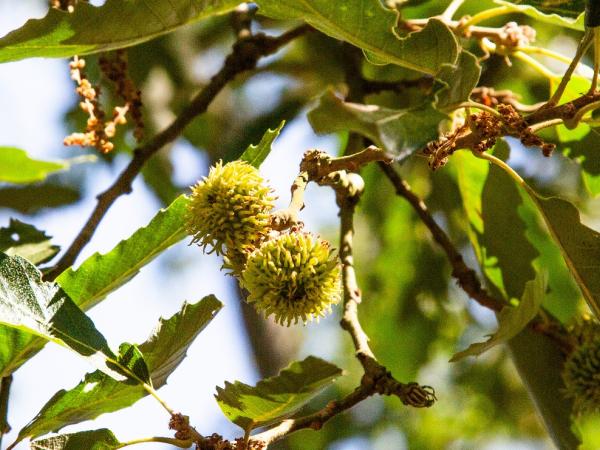
The only oak species endemic to Africa is rare in cultivation. It shouldn't be.
 |
| Bees pilfering pollen © Roderick Cameron |
Bees are thieves! It’s official! After my recent note pointing out that bees were seemingly harvesting pollen from a Quercus suber without any commensurate benefit to the tree, serendipitously the latest issue of the magazine The Plantsman contained an article giving a synopsis of research into "bee plants" by the National Botanic Garden of Wales, prompted by the alarming dip in global bee numbers.
Many of you may know this already, but for those as steeped in ignorance as I was: for nutritional balance honey contains not only the nectar of which I was aware, which gives sugar (thus energy) and trace elements; but also pollen for both the protein and the lipids (fats) needed for the physical development of the bee colony. Logically, being wind pollinated, oaks do not waste their energy producing nectar, but nevertheless, listed in order of frequency found in the honey, the genus Quercus weighs in at number 9 (albeit that number 2 in the list is an amalgam of the three genera Crataegus, Malus, and Cotoneaster, indistinguishable by the DNA metabarcoding method used). These "top 10" accounted for a surprising 96% of the DNA found. So next time you crack open a jar of honey, if it came from a region in which oaks grow there is a high probability that stolen oak pollen will be a constituent. And exotic oak plantings, in which different species of oaks can produce pollen from April or earlier through to June (in the Northern Hemisphere) would thus seem to be a valuable if unlikely resource in the fight for bee survival. (Incidentally, the research also showed that the "pollinator-friendly" labeling one sees in plant nurseries should be treated with caution, but that’s another story…)
Content by the Same Author
The International Oak Society acknowledges the generous support of the following institutions:
Supporting Institutional Members



Standard Institutional Members