Editor's Picks

While working on a list of synonyms of European White...
Roderick Cameron
|
Aug 24, 2026
Report led by The Morton Arboretum will help prioritize oak...
Website Editor
|
Aug 06, 2026
Motivation
I live in the village of Dolné Dubové...
Jozef Čapkovič
|
Jul 20, 2026
Plant Focus
The only oak species endemic to Africa is rare in cultivation. It shouldn't be.
Designing silvopasture systems that farmers actually want
Mention trees or forestry to many Welsh livestock farmers, and you will often get a less-than-enthusiastic response, unfortunately. The upland topography and low-fertility soils of my country make agriculture challenging, but forestry is an attractive alternative land use for both government and the forestry industry based over the border in England. Thus, since the 1930s the state forestry service (Forestry Commission) and private sector forestry companies have acquired large tracts of upland former farmland in Wales and planted them largely with Picea sitchensis (Sitka spruce). More recently, the private sector has continued to acquire land—typically when a farm goes up for sale after a death—and to plant similar monocultures to acquire carbon credits that can be traded.
During the development of the Welsh Government’s new Sustainable Farming Scheme, a proposal was mooted requiring farmers to plant 10% of their land with trees in order to access agricultural support grants. Although that idea was dropped, all of this has led to a distrust among farmers of trees and woodlands in the uplands, and this is a great pity. Livestock farming dominates the Welsh agricultural sector, and the shelter and other benefits that can accrue from trees should be welcomed by farmers. But far too often that’s not the case.
How can we convince livestock farmers of the benefits of tree cover? That question prompted my husband and me to make our small farm a demonstration site for different approaches to silvopasture, and to set up a company, Pembrokeshire Agroforestry, to provide a consultancy service and planting stock. It also prompted me to apply for a Nuffield Farming Scholarship to study silvopasture on livestock farms in other countries. I was successful, and I will soon be travelling to Japan to attend the Nuffield International Contemporary Scholars Conference, where I hope to meet with other Society members.
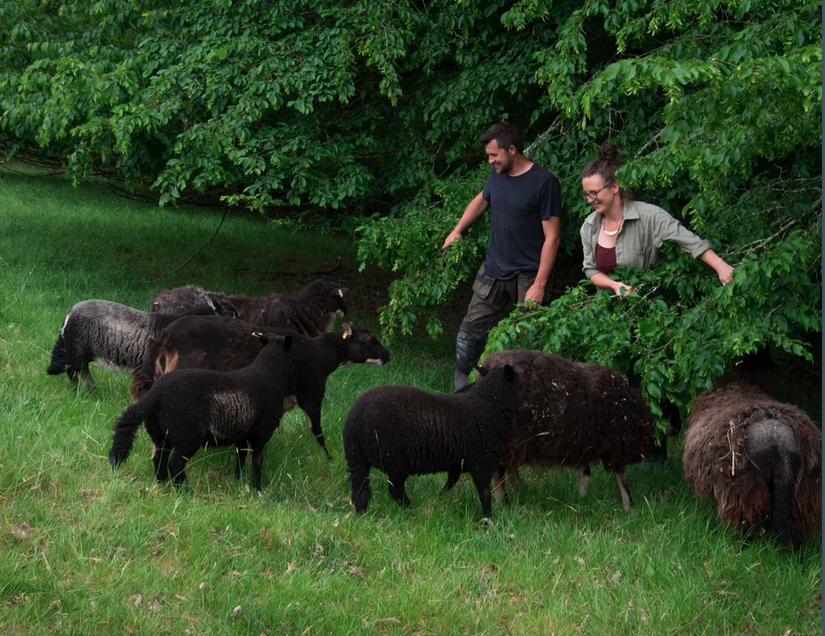
© Amanda Jackson and Pembrokeshire Agroforestry
On my return I start a tour of ten countries—Ireland, England, Scotland, Wales, the Netherlands, Sweden, Norway, Spain, Portugal, and Morocco—to investigate best practice in silvopasture that can then be implemented on the ground back home. Inevitably, various oak species will be a substantial element of the systems that I wish to study. I’m particularly interested in researching examples of silvopasture of all scales: tree hay and silage; pollards in pastures; innovative designs for browse access and tree protection; trees as a core part of the daily ration for ruminants; the effect of silvopasture on ecosystems and biodiversity; tree crops adding value, e.g., biomass, nuts, fruit; a variety of tree species as animal feed; and trees culturally embedded in farm practice.
I would be immensely grateful for any help that Society members in these countries could offer me. This might take the form of sharing your experience of silvopasture, recommending people and places to visit, and sending me details of events, projects, and networks that may be of interest. I will be travelling largely by electric van with a bed in the back, but I’m sure that I would appreciate the offer of a bed for the night. My contact details are in the Membership Directory (Jacqui Banks) or you can access them here (available only to IOS members, you will need to log in first).
I’m a new member of the International Oak Society and I look forward to meeting you!
Editor's Note: At the 11th IOS Conference in Oaxaca, Byron Joel presented on silvopasture projects in Australia. His article will appear in the Proceedings (International Oaks No. 37, due to be published around May 2026), and a video of his presentation is available here.
The International Oak Society acknowledges the generous support of the following institutions:
Supporting Institutional Members



Standard Institutional Members