Editor's Picks

While working on a list of synonyms of European White...
Roderick Cameron
|
Aug 24, 2026
Report led by The Morton Arboretum will help prioritize oak...
Website Editor
|
Aug 06, 2026
Motivation
I live in the village of Dolné Dubové...
Jozef Čapkovič
|
Jul 20, 2026
Plant Focus
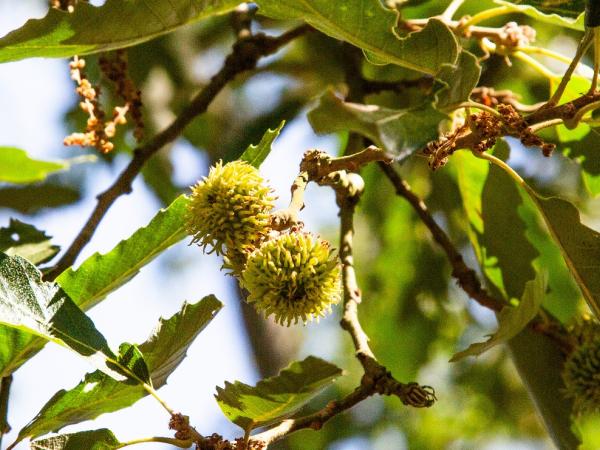
The only oak species endemic to Africa is rare in cultivation. It shouldn't be.
IOS member Elif Deniz Ülker is the co-author, with Çağatay Tavşanoğlu, both of the Hacettepe University, Ankara, Türkiye, of a paper recently published in the Journal Ecology and Evolution which examines the likely future range of six mainly European species of oak in the climates that might be endured during the period 2081 to 2100 (Oaks and Climate Change: Contrasting Range Responses of Mediterranean and Temperate Quercus Species in the Western Palearctic1).
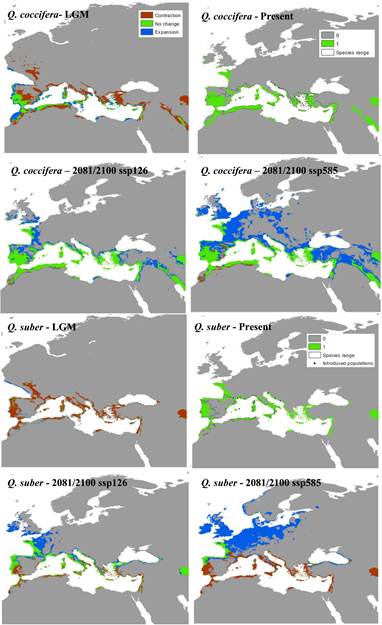
In selecting the oak species to be studied, and aiming to represent the dominant oak taxa of the climatic zones of the study area, the authors opted for two that represent the Mediterranean zone, Quercus suber (cork oak) and Q. coccifera (kermes oak), while the temperate zone to the north is represented by Q. robur (pedunculate oak) and Q. petraea (sessile oak). In addition, they identified a transition zone, the oaks of which span the two previous ranges. It is represented by Q. cerris (Turkey oak) and Q. pubescens (downy oak). This grouping had the advantage of representing both the oaks’ ecological and phylogenetic ranges, covering sections Ilex, Quercus, and Cerris. For occurrence data, the authors turned to the Global Biodiversity Information Facility (GBIF), regional floras (Hedge and Yaltırık 1982; Tutin et al. 1964–1980; Vila-Viçosa et al. 2023), and the European Forest Genetic Resources Program (EUFORGEN), filtering for clear recording errors. They acknowledged that under-recording in some areas, including North Africa and Anatolia, could lead to range uncertainty.
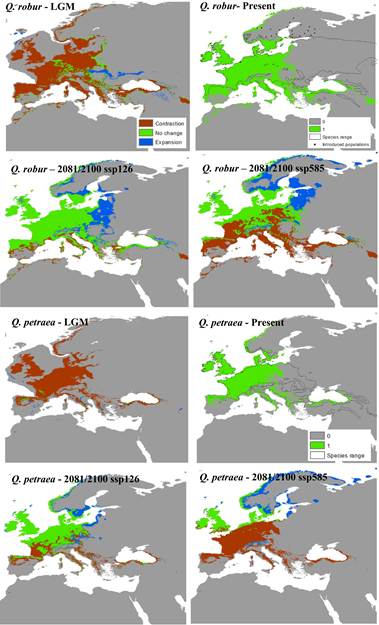
The aim of the study was to use ecological niche modelling (ENM) to hindcast the likely range of each of the six species at the time of the last glacial maximum (LGM) around 22,000 years b.p.; to model their current ranges based on climatic zones; and to forecast ranges in the period 2081 to 2100 under two climate change scenarios. For this they employed two of the Shared Socioeconomic Pathways used for such forecasting by the Intergovernmental Panel on Climate Change (IPCC): SSP1-2.6, which is relatively optimistic (although it assumes that the Paris Climate Agreement targets are not met, with carbon dioxide concentrations reaching net zero around 2075) and SSP5-8.5, representing very high greenhouse gas emissions, with carbon dioxide concentrations tripling by 2075.
For each of the oak species and each time period, the modelling derived latitudinal centroid shifts, southern and northern range limit shifts, area changes relative to the present distribution, and changes in north–south range extent. The models generally indicated a strong concordance with the current distributions of all six species, failing only to establish the eastern extent of the ranges of Q. robur and Q. petraea. The authors suggest that this may reflect the scarcity of records from these regions but possibly also the effects of other factors which were not considered by the study. Caution in interpretation of purely climatic modelling is indicated.
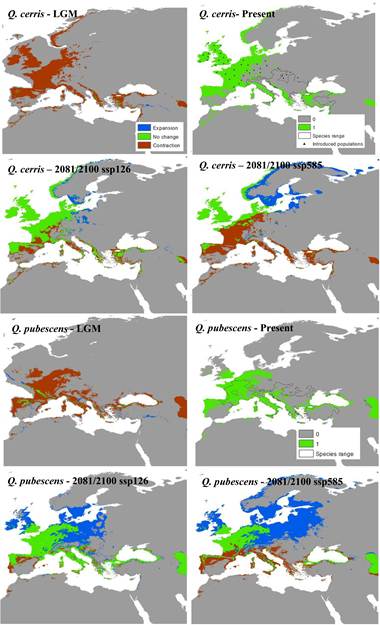
The modelling for LGM conditions indicated significant range contractions for both the temperate and transition zone oak species, with retreat to refugia in southern Europe, consistent with previous studies. Besides the already well-established areas in the Iberian Peninsula, Italy, and the Balkans, it identified Anatolia as a suitable refugium for the transition zone species, Q. cerris and Q. pubescens. In contrast the Mediterranean oaks (Q. coccifera and Q. suber) maintained more stable ranges during the LGM, with minimal changes.
Under the future projections the temperate species are likely to suffer significant range loss, partly moderated by northward shifts into Scandinavia where other factors allow, especially under the pessimistic SSP5-8.5 scenario. More southerly populations may face extinction. The transition zone species should show intermediate responses, with some range loss but better resistance compared to temperate oaks. The Mediterranean species could experience some slight southern range loss but some considerable northward expansion, again where other factors allow.
The authors stress that these forecasts represent estimates of the future climatic niches of these species. The modelling could not take account of other potentially limiting factors such as competing land uses and lack of habitat connectivity. They caution that “our results should be interpreted as estimates of potential climatic niches, rather than definitive predictions of realized future ranges . . . ENM outputs should be viewed as testable hypotheses rather than definitive forecasts.” Nevertheless, the work points to some important implications for the conservation of oak species. The temperate and transition-zone oaks are likely to require conservation strategies to enhance connectivity and genetic diversity, and to monitor and address emerging threats such as pests and pathogens. The Mediterranean oaks are more resilient but will need adaptive management to address drought and fire risks. A timely and important warning.
To access the paper, click here.
Works cited
Hedge, I.C., and F. Yaltırık. 1982. “ Quercus L.” In Flora of Turkey and the East Aegean Islands Vol. 7, edited by P. H. Davis, pp. 659–683. Edinburgh: Edinburgh University Press.
Tutin, T., V. Heywood, A. Burges, and D. Valentine. 1964–1980. Flora Europaea Vols. 1–5. Cambridge: Cambridge University Press.
Vila-Viçosa, C., J. Capelo, P. Alves, R. Almeida, and F. M. Vazquez. 2023. New Annotated Checklist of the Portuguese Oaks (Quercus, Fagaceae). Mediterranean Botany 44: e79286. [link]
1 The Western Palearctic is the western portion of the Palearctic biogeographic realm, including Europe, North Africa, parts of the Arabian Peninsula, and temperate Asia up to the Urals.
Content by the Same Author
The International Oak Society acknowledges the generous support of the following institutions:
Supporting Institutional Members



Standard Institutional Members