Editor's Picks

While working on a list of synonyms of European White...
Roderick Cameron
|
Aug 24, 2026
Report led by The Morton Arboretum will help prioritize oak...
Website Editor
|
Aug 06, 2026
Motivation
I live in the village of Dolné Dubové...
Jozef Čapkovič
|
Jul 20, 2026
Plant Focus
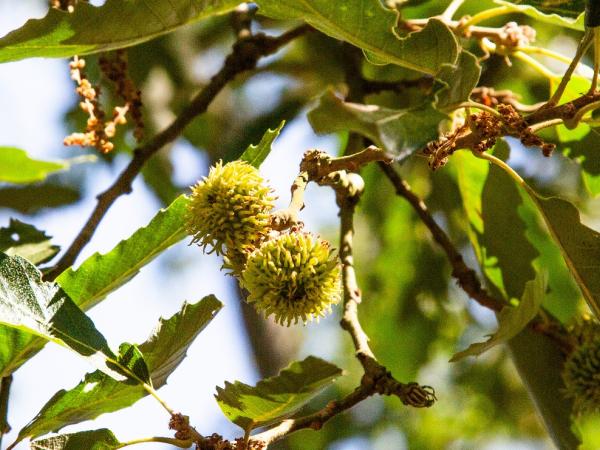
The only oak species endemic to Africa is rare in cultivation. It shouldn't be.
There seems to be a good deal of confusion regarding the cultivar published as Quercus texana ‘New Madrid’ in 2007 by Eike Jablonski, and there are a number of reasons why that confusion exists. So, let’s start at the beginning.
In 1999, past IOS President Guy Sternberg discovered a mature Nuttall oak (Q. texana) in southern Missouri’s New Madrid County1 (for readers outside the US, it is worth pointing out that the pronunciation is MAD-rid, not Ma-DRID like the capital of Spain). Seed collected from this tree was grown at Starhill Forest Arboretum, Petersburg, Illinois; from a handful of individuals Guy selected his favorite plant, which was registered as ‘New Madrid’. This excellent cultivar features a wine/purple spring flush, red fall color, and has a uniform pyramidal crown. Around the same time, Guy sent scions of this selection to Dirk Benoit at Pavia Nursery, Belgium for propagation. This selection ended up in other European nurseries as well as Forrest Keeling Nursery in Elsberry, Missouri. These vegetatively propagated (grafted) trees are the only true forms of the cultivar ‘New Madrid’.

What seems to be contributing to the confusion is the fact that seedlings originating from the parent tree produce quite uniform plants with very similar features to the cultivar. However, these are siblings, not to be confused with the named cultivar. A new selection from one of these seedlings would need a new name if it were to be reproduced (vegetatively) in the future. Complicating matters further is the fact that seed has been distributed in Europe and the US, and may have been erroneously labeled and even marketed as the cultivar ‘New Madrid’.

One further complication to this puzzle: Although originally registered as a Nuttall oak cultivar, Mr. Sternberg has had suspicions for some time that this selection might in fact be an F1 hybrid. Quick growth rate, atypical foliage, increased hardiness, and branching habit all hinted at hybrid parentage. In 2017, the original F1 seedling registered as ‘New Madrid’ flowered and set seed for the first time. It was the last piece of the puzzle that made it clear this cultivar was in fact a hybrid with Q. palustris. The intermediate cups and acorns (thin, shallow cups and short, rounded acorns like pin oak), along with the other characteristics, make it quite clear. Records should be amended to reflect this change. Quercus ‘New Madrid’ or Q. palustris × texana ‘New Madrid’ is now the correct way to list this cultivar as no official epithet exists to recognize this hybrid.

A New Madrid Group was proposed to provide a name for all of the sibling plants that exist in Europe and the US. However, New Madrid cannot be used for both a Group and a cultivar and it seems best to retain it for the cultivar. In addition, there are now several selections or hybrids of Nuttall oak that have a red spring flush. A new Group name that would include all of these selections has been proposed and will soon be published.2 While it is certainly possible that some of the seedlings from the original tree in New Madrid are pure Nuttall oak, the majority of those raised at Starhill Forest and by the author appear to be F1 hybrids.
1 See Russell, R. 2013. The Unique Nuttall Oak Tree at New Madrid, Missouri. International Oaks 23: 50–55.
2 Russell, R., E.J. Jablonski, and A.J. Coombes. 2021, in press. New and Lesser-Known Oak Cultivars 2020. International Oaks 32.
Content by the Same Author
The International Oak Society acknowledges the generous support of the following institutions:
Supporting Institutional Members



Standard Institutional Members