Editor's Picks

While working on a list of synonyms of European White...
Roderick Cameron
|
Aug 24, 2026
Report led by The Morton Arboretum will help prioritize oak...
Website Editor
|
Aug 06, 2026
Motivation
I live in the village of Dolné Dubové...
Jozef Čapkovič
|
Jul 20, 2026
Plant Focus
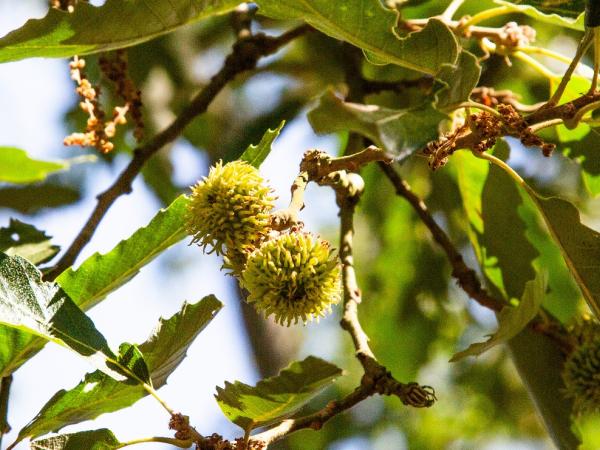
The only oak species endemic to Africa is rare in cultivation. It shouldn't be.
There are a growing number of unique hybrid selections that feature Quercus rysophylla as one parent. Quercus rysophylla is apparently quite prone to outcrossing with other Lobatae section oaks, or maybe it just seems that way as most of these selections have come out of cultivated collections. In any case, the two selections featured here are a couple of the older cultivars, but two newer selections, Q. ‘Belle d’Aquitaine’ (selected by Béatrice Chassé from a plant growing at Arboretum des Pouyouleix, France) and Q. ‘Chocha’ (selected by Francisco Garin from a plant at Jardín Botánico de Iturraran, Spain), exist as well, and you can read up on all of these in greater detail in the 2015 International Dendrology Society Yearbook article by Allen Coombes.1

Quercus ‘Maya’ is a medium-sized evergreen tree grown for its ornamental immature leaves which emerge bright pinkish-red and slowly turn a glossy green. Of the Q. rysopyhlla hybrid selections, ‘Maya’ is most like its known parent species, differing notably in the variable lobed and toothed margins of its leaves.

‘Maya’ was originally received as a seedling at Bömer Nursery, Zundert, the Netherlands, from Mallet Court Nursery, UK. ‘Maya’ has been offered by European nurseries such as Bömer Nursery and Pavia Nurseries, Belgium. In addition to its spring color and overall beauty, it has become popular in Europe for its hardiness. ‘Maya’ was designated as ”Best Novelty” at the Groot Groen exhibition in Zundert, the Netherlands in 2006.

Quercus ‘Zehra’ is a tree of medium size, grown for its ornamental evergreen habit. Leaves are unique in that they typically display three prominent lobes reminiscent of Q. falcata, and subsequent observations have suggested that Q. falcata could be the other parent. It was discovered at Karaca Arboretum, Yalova, Turkey during a 2002 IOS tour. Though labeled as Q. rysophylla, it was of obvious hybrid origin. Scions were sent to Pavia Nursery where it was propagated and named ‘Zehra’ after the daughter of the late Hayrettin Karaca, owner of Karaca Arboretum.

This selection has proven hardy to temps as low as -29 °C.2 The ortet of ‘Zehra’ originated in the US, but exact origins are unclear. It is possibly a sister seedling to a hybrid at Rosemoor Gardens, Devon, UK also thought to be a Q. rysophylla × falcata. Ultimate size is unknown, but the original plant at Karaca Arboretum is over 10 m tall.

1 Coombes, A. 2015. Tree of the Year: Quercus rysophylla Weath. International Dendrology Society Yearbook 2015: 22-52.
2 Chassé, B. 2013. Taking Oaks to the Limit in the Czech Republic. International Oaks 26: 77-88.
Content by the Same Author
The International Oak Society acknowledges the generous support of the following institutions:
Supporting Institutional Members



Standard Institutional Members