Editor's Picks

While working on a list of synonyms of European White...
Roderick Cameron
|
Aug 24, 2026
Report led by The Morton Arboretum will help prioritize oak...
Website Editor
|
Aug 06, 2026
Motivation
I live in the village of Dolné Dubové...
Jozef Čapkovič
|
Jul 20, 2026
Plant Focus
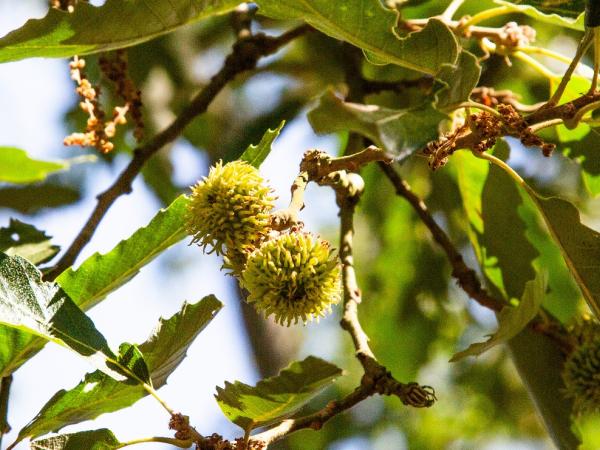
The only oak species endemic to Africa is rare in cultivation. It shouldn't be.
It was a great pleasure for me to be able to write about my 31 years of involvement with Arboretum Trompenburg in Rotterdam. Dick van Hoey Smith, who founded the Arboretum, had published two books1 about the place he inherited and where he put a lot of effort into expanding the collection. Now it was up to me to write up the continuing development of what became Arboretum Trompenburg in 1958 and had a name change in 2008 to Trompenburg Tuinen & Arboretum (Trompenburg Gardens & Arboretum).

As regards the oaks in the collection, I was able to add information on the origin of some of the oaks that were planted by Dick. For example, we had been puzzled about the origin of our Quercus robur ‘Pendula’, a weeping form of English oak. According to Dick’s records he had spotted the mother tree while on a bus in Hamburg in 1953. He was so taken by the tree that he immediately took a taxi back to photograph it and collect acorns. He wrote on the photograph that the tree was on Kädenstrasse, but when we tried to find the oak, there was no street by that name in Hamburg. I was able to enlist the help of friends in the German Dendrological Society, one of whom recognized the location, which turned out to be on Körnerstrasse! Unfortunately, the weeping oak is no longer there…

There are several weeping forms of Q. robur mentioned in the book. A name that appears in old literature is Q. robur ‘Dauvessei Pendula’, of which Cornelis de Vos wrote in 1867 that it is “a very beautiful weeping tree.” With this name, De Vos referred to the French tree nursery Établissement horticole de Transon-Gombault et D. Dauvesse in Orléans. In their catalog from 1845, a weeping oak is offered with the qualifications “very rare” and “high grafted as standard”; the offer price of 5 francs is far above the average price for trees and shrubs in those days. It is unclear whether De Vos saw this weeping oak himself or whether he based his information on the information from the French catalog. Unfortunately, it is now no longer possible to determine exactly which of the old still-existing weeping oaks it is. In some places in Europe you can find large weeping oaks in old parks or gardens, all of which can date from shortly after 1850. These specimens, still present in Het Hemelrijk, Belgium, the Schlosspark Gotha, Germany, and at Vallø Castle, Denmark (all pictured in the book), have similarities in their weeping habits, but they all seem slightly different. Unpruned, they have grown into large trees with a broad crown and strongly overhanging outer branches. One of them may belong to what C. de Vos called ‘Dauvessei Pendula’ at the time. It became common practice to give all weeping oaks the name Q. robur ‘Pendula'’ in the catalogs. A group name has been installed for some time now for the various weeping forms of the pedunculate oak: Q. robur Pendula Group.
Dick sometimes named the cultivars he selected by combining the names of the parent species. A well-known example is Q. ‘Pondaim’, a hybrid between Q. pontica and Q. dentata (sometimes called daimyo oak, using the common name in Japanese). Another is Q. ‘Macon’, which is a hybrid between Q. macranthera and Q. frainetto (at one time called Q. conferta). What I was able to find out is that it almost got a slightly different name. I found an article that predates the publication date of the name ‘Macon’ in which the author interviewed Dick and quotes him as considering the name ‘Macracon’ for the seedling. Why Dick later changed his mind and named it ‘Macon’ we do not know. It is my assumption that Dick (or his wife Riet) thought that it was too similar to a cookie named maccaron or even too close to the type of pasta macaroni.

Another interesting oak anecdote is the story behind Q. cerris ‘Curly Head’. Maarten Bömer spotted four strangely shaped seedlings in a seed bed with hundreds of Q. cerris in his nursery. This one was the most striking of the four and he decided to propagate it. He told me he thinks it is his best introduction. The original seedling has grown into a narrow upright tree. The leaves are strongly curled, concave, and shiny, similar to a person's curly hair. In Dutch we call a person with hair like that krullenkop (literally “curly head”).


One remarkable story concerns a mature Q. acuta specimen that has been grafted on Q. robur rootstock. These are unrelated species in different subgenera (Q. acuta from section Cyclobalanopsis in subgenus Cerris and Q. robur from section Quercus in subgenus Quercus), so one would normally not expect the graft to succeed. And yet the tree still stands, with the site of the graft clearly visible where the bark transitions from smooth (Q. acuta) to fissured (Q. robur). One can also see that roots have formed from the Q. acuta section of the trunk and run down the Q. robur section to the soil. Perhaps that is the reason the tree survives, as the Q. acuta is in part growing on its own roots.

Thanks to the contacts and friendships in the International Oak Society, we were able to enlarge the oak collection substantially. In all, the book mentions just over one hundred different species and cultivars of oaks, and many more woody ornamentals, perennials, and succulents that were added over a period of 31 years. At the moment only a version in Dutch is available (click on the image below for more information).

1 van Hoey Smith, J.R.P. 2001. Arboretum Trompenburg, Bomenrijk in Rotterdam. Rotterdam: Stichting Bevordering van Volkskracht. (in Dutch; English version published under the title Arboretum Trompenburg: Green Oasis in Rotterdam)
van Hoey Smith, J.R.P. and J. Voskuil. 1983. Bomenrijk in Rotterdam. Rotterdam: Arboretum Trompenburg. (in Dutch; English version published under the title Trees in Rotterdam)
Content by the Same Author
The International Oak Society acknowledges the generous support of the following institutions:
Supporting Institutional Members



Standard Institutional Members