Editor's Picks

While working on a list of synonyms of European White...
Roderick Cameron
|
Aug 24, 2026
Report led by The Morton Arboretum will help prioritize oak...
Website Editor
|
Aug 06, 2026
Motivation
I live in the village of Dolné Dubové...
Jozef Čapkovič
|
Jul 20, 2026
Plant Focus
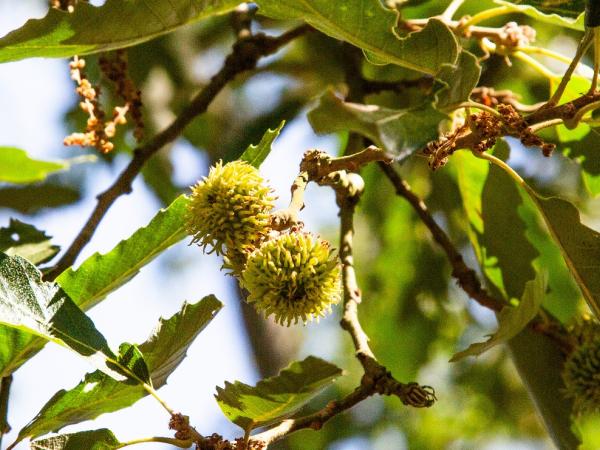
The only oak species endemic to Africa is rare in cultivation. It shouldn't be.
Bhutan is a mountainous kingdom in Eastern Himalaya, bounded on the south by India’s Assam district. Less than 15% of its area lies below 400 metres (1,310 feet) altitude, and nearly 76% at over 1,200 metres (3,940 feet). Precipitation varies enormously from 5,000 mm/year (197 inches) in the tropical south to 400 mm/year (16 inches) or less on the high northern plateaux.
The evergreen oak woodland zone is quoted as being found on southern aspects at altitudes of between 1,800 and 2,600 metres (5,906 to 8,530 feet), mixing and grading into Pinus roxburghii at the lower boundary and Pinus wallichiana above. But, as elsewhere, oaks have apparently not read the books, and insert themselves liberally into other zones, even sometimes at over 3,000 metres altitude (9,843 feet).
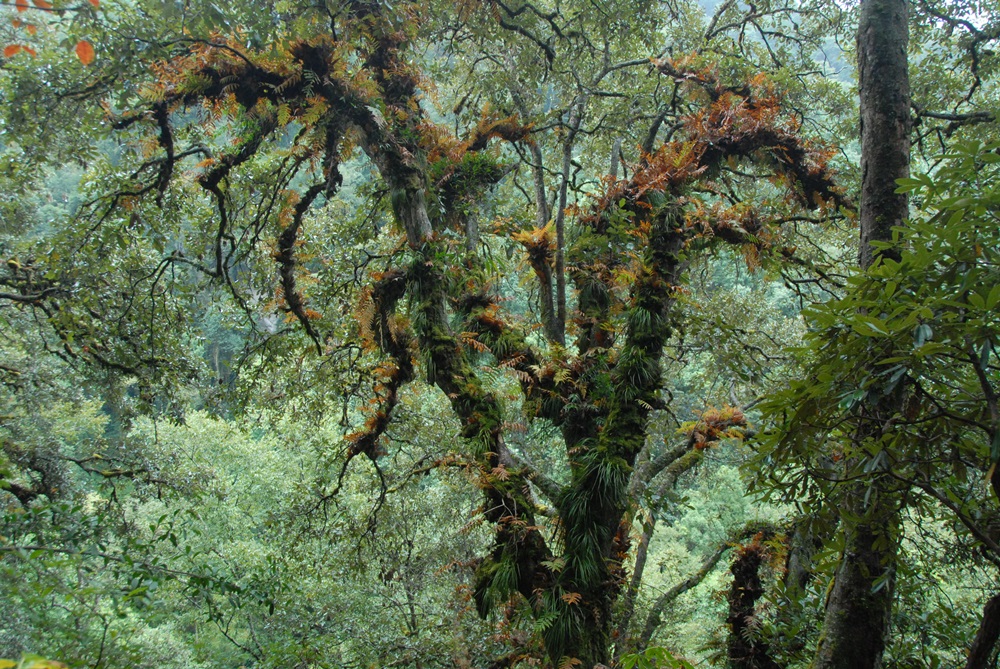
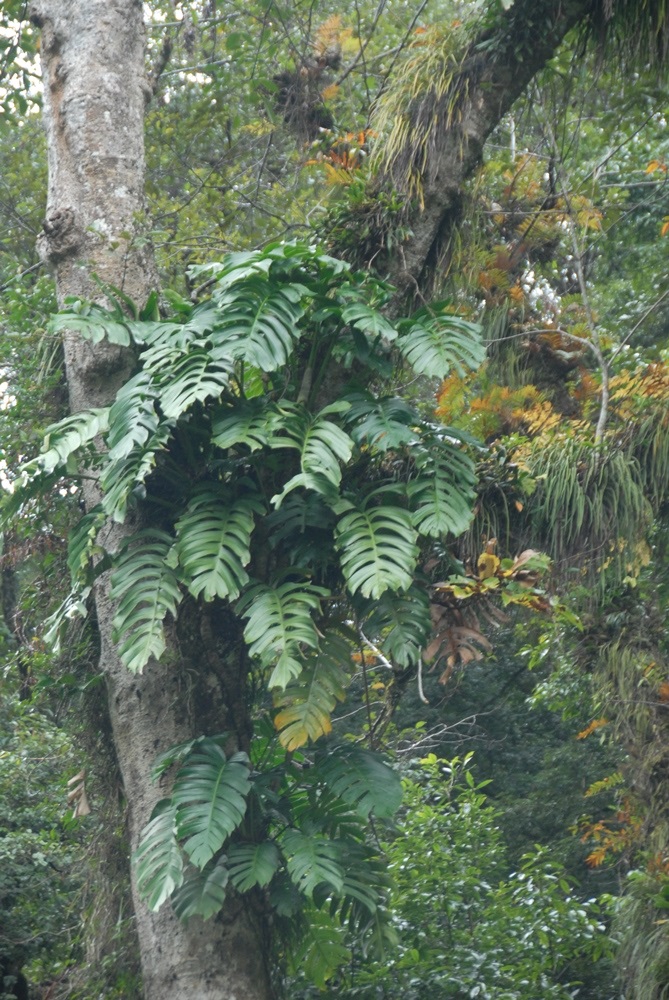
The Flora of Bhutan includes six species of oak: deciduous Quercus griffithii, and the evergreens Q. glauca, Q. lamellosa, Q. lanata, Q. oxyodon and Q. semecarpifolia, all of which are widely distributed, sometimes forming forests of a single species, with Q. glauca being the least common in the areas we visited starting in the east at Tashigang and travelling west to Thimpu and Paro with various asides. We also saw at least three species of Lithocarpus. The accessible oaks are often lopped for fodder and animal bedding, giving them an unnatural appearance, and, as in many countries, they are the prime choice for firewood; but Bhutan is such a well-forested country that none are in danger, although road and dam construction will continue to take a toll. In this Buddhist country, trees either growing near temples or otherwise associated with the spirit world by the inhabitants are protected and can reach great sizes. In the more humid areas the trunks are often gardens of epiphytes, as some of the following photos show.
And what of the temptations of the title? Well, there is a strict law in Bhutan that no seeds or plant material may be taken out of the country. As we crunched our way over paths littered with acorns of Q. griffithii and Q. lanata (mercifully, Q. oxyodon and Q. semecarpifolia seemed to be having an ‘off’ year) you can probably imagine the excruciating agonies of temptation we had to overcome, a temptation only marginally reduced by the fact that they were often embedded in, ahem, animal products… or should I just say fertiliser?
(Photo credits: Anke Mattern and Shaun Haddock.)
 |
|
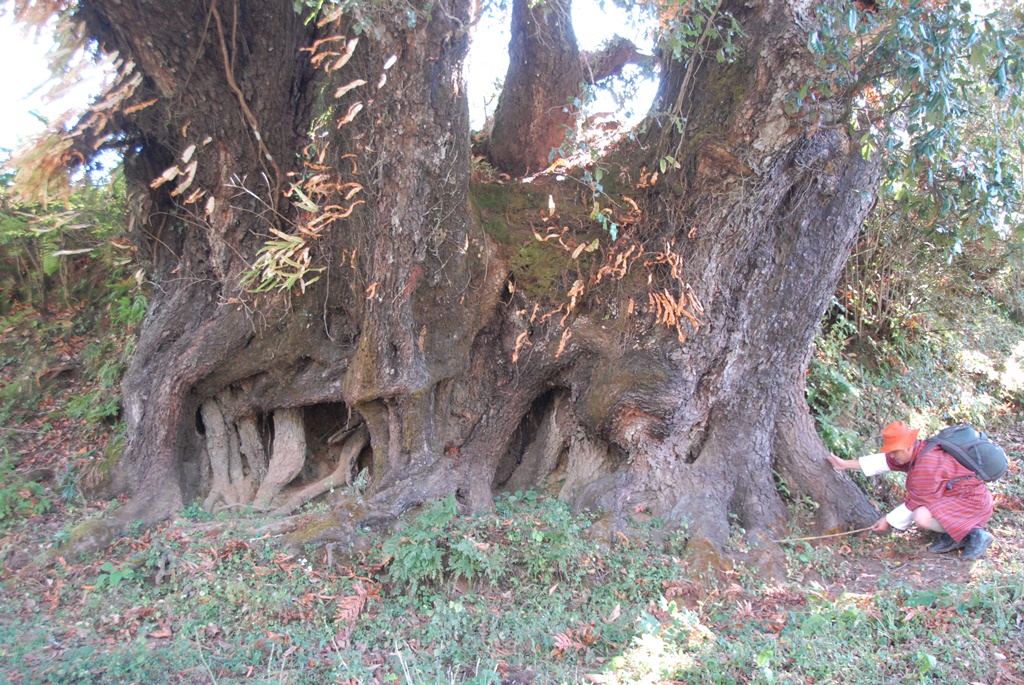
The base of an enormous Quercus semecarpifolia at 2,690 metres (8,825 feet) in the Dangchu valley, near the Dogsen monastery. This marvellous tree has a crown spread of 38 metres (125 feet), and a trunk diameter of 5.75 metres (19 feet) at the base. During the life of the tree, the soil has eroded on the downhill side of the trunk, and is now 4.2 metres (14 feet) lower than on the uphill side! |
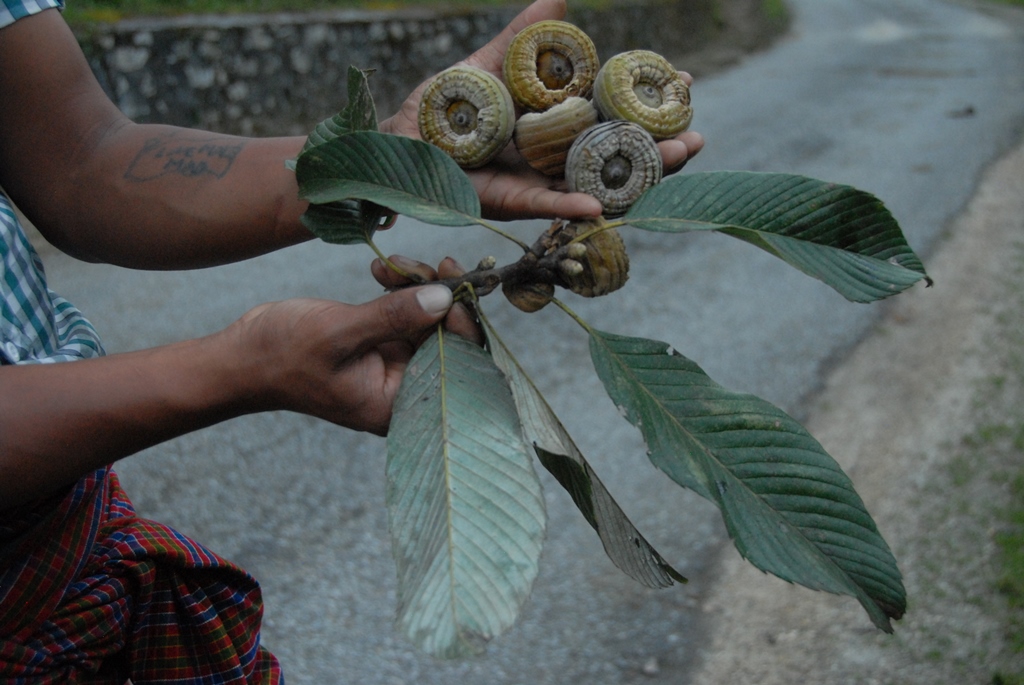 |
| On the road between Trashigang and Mongar in eastern Bhutan, Grey Langur monkeys providentially attracted our attention. On stopping we found a tree of Quercus lamellosa displaying the large and attractive acorns. This tree is generally found between 2,100 and 2,700 metres (6,890 and 8,860 feet) in Bhutan. |
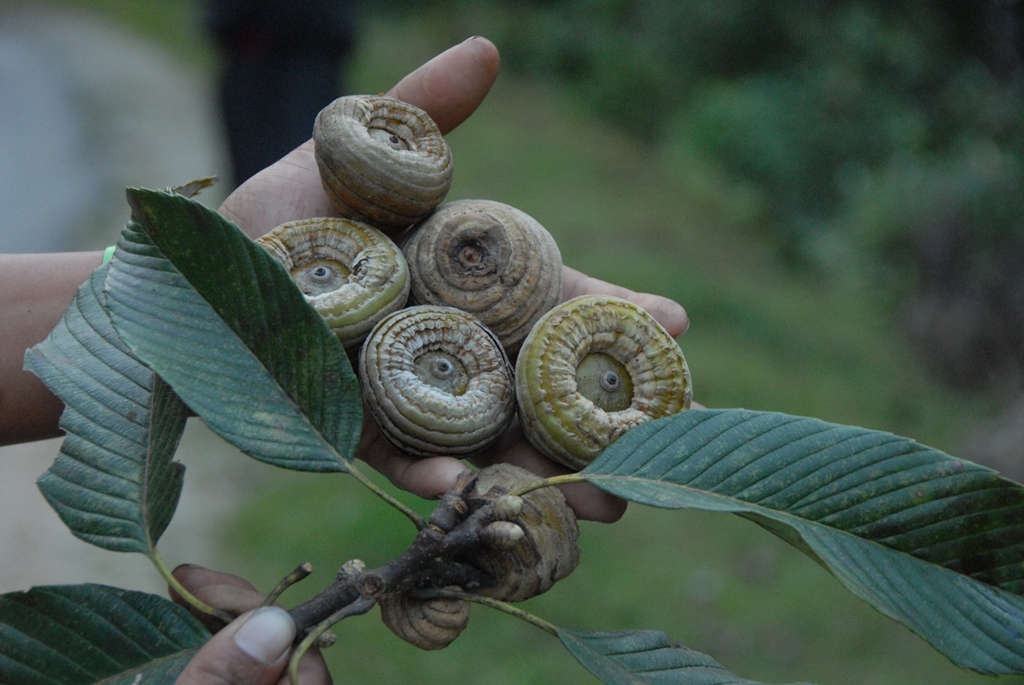 |
| Quercus lamellosa acorns. |
 |
|
Some of the Quercus lanata in the valley of the Gamri Chu between Tashigang and Sakten are beautiful hanging gardens of epiphytes. |
|
|
|
Humble pie! A photograph published in Oak News and Notes Vol. 17 No. 2 (see here, p. 4) showed Monstera deliciosa growing on Quercus leucotrichophora in the Stellenbosch Botanic Garden in South Africa, and in the associated article I snidely suggested this was an unlikely combination. So here is my come-uppance – Monstera growing on the closely related Q. lanata in the wild between Tashigang and Sakten. |
Content by the Same Author
The International Oak Society acknowledges the generous support of the following institutions:
Supporting Institutional Members



Standard Institutional Members