Editor's Picks
Images and insights from Ezra Barnea’s journey to Cyprus’s...
Ezra Barnea
|
Jun 13, 2026
Endangered oak Quercus hinckleyi shows strong genetic...
Website Editor
|
Jun 09, 2026
New paper should significantly change our approach to...
Steve Potter
|
Jun 09, 2026
Plant Focus
Roderick Cameron and Carlos Vila-Viçosa give an account of this intriguing species from northwestern Iberia with a complex taxonomic and...
After an inspiring week at the IOS Conference in Oaxaca, a group of 38 oak enthusiasts gathered at Hotel Victoria for the beginning of the Post-Conference Tour. Over six days, we crossed valleys, climbed into cloud forests, and trekked through the landscapes of the Mixteca Alta. Under the guidance of Antonio González and Oscar de Luna Bonilla, whose enthusiasm for the flora and the communities of the region was evident at every turn, we explored an impressive range of habitats and encountered some 16 species of Quercus. The tour was both botanically rich and culturally grounding; a reminder of how deeply oaks and the people of Oaxaca shape each other.
Day 1: A Muddy Start in San Pablo Etla
Our adventure began with a literal "push". We departed the Hotel Victoria early in the morning for San Pablo Etla, a community-led conservation area just 14 km north of Oaxaca City. Heavy rains the previous evening had transformed the steep, unpaved entrance to the community into a slick barrier. When our vans lost traction and began to slide, the solution was simple: we unloaded and, with a collective heave, successfully pushed the empty vehicles up the mud-caked slope.

© Wally Wilkins
With the mud conquered—and our boots significantly heavier—we took a moment to admire the roadsides lined with native Cosmos sulphureus, their brilliant orange and yellow blooms glowing against the dark, wet soil.
Upon reaching the reserve proper, we split into two smaller groups to navigate the terrain. My group embarked on a hike up a rough gravel road, climbing steadily for several hundred feet over the course of a mile or two.

© Roderick Cameron
The atmosphere was dramatic; while the sky above the Oaxacan valley began to clear, revealing spectacular views of the landscape below, the surrounding hilltops remained shrouded in the remnants of the previous night’s storm clouds. The botanical reward for the climb was immediate. We identified seven oak species in short order: three Red Oaks (Section Lobatae)—Quercus conzattii, Q. mexicana, and Q. castanea—and four White Oaks (Section Quercus)—Q. liebmannii, Q. glaucoides, Q. magnoliifolia, and Q. peduncularis.
Day 2: The Tehuacán-Cuicatlán Biosphere Reserve
On the second day, the reality of travel set in. A stomach bug unfortunately sidelined me, forcing me to trade the field for a day of recovery at the hotel. For the account of this day’s excursion, I am indebted to Roderick Cameron, whose detailed notes allow us to complete the story of the tour.

© Roderick Cameron
The group set off due north bound for San Juan Bautista Cuicatlán. Leaving the cool highland slopes of Oaxaca shaded by oak and pine forests, the road descended into a dramatic landscape shift. The vegetation transitioned to tropical dry forest dotted with copal trees (Bursera sp.), mesquite (Neltuma sp.), and various Agave species. As they approached the Tehuacán-Cuicatlán Biosphere Reserve, the valley opened into a striking panorama dominated by towering columnar cacti and thorn scrub—a dramatic contrast to the greenery left behind.

© Roderick Cameron
Upon reaching Santos Reyes Pápalo, the group was greeted by local hosts with coffee and mole before exploring the area around the community center. The primary oak viewing took place on the descent back down to San Juan Bautista Cuicatlán. Roderick noted that Quercus magnoliifolia was a standout species here, one rarely encountered elsewhere on the tour, distinguished by its huge leaves. It was found growing alongside Q. liebmannii, a species it resembles, though Q. magnoliifolia was distinguished by larger leaves with shallow lobing and an underside featuring slightly yellowish tomentum.

© Emily Griswold
They also observed Q. conzattii again; unlike the stunted trees seen previously at Hierve el Agua, on one of the Conference Field Trips, the specimens here were medium-sized trees.

© Roderick Cameron
The group also made an exceptional non-oak stop to admire a gigantic Pachycereus weberi, its many upright arms branching out like a massive candelabra, before returning to San Juan Bautista for their evening meal.
Day 3: Into the Cloud Forest of Ixtlán de Juárez
Recovered and ready, I rejoined the group for what would be the highest elevation day of the tour. We traveled northeast to Ixtlán de Juárez in the Sierra Norte de Oaxaca. The drive took us up a long, winding road deep into the cloud forest, a magical environment where every surface was cloaked in a green and gold blanket of lichens, mosses, and bromeliads.

© Roderick Cameron
Walking across the forest floor felt like strolling on a mattress; each step was cushioned by years of accumulated moss and leaf litter. Our primary target here was the Oaxacan endemic Q. macdougallii.

© Emily Griswold
We were incredibly fortunate: the floor was littered with a bounty of acorns. Antonio informed us that this was a mast year for Q. macdougallii, an event that had not occurred in the last decade.

© Wally Wilkins
Descending midway down the mountain, we stopped to marvel at some massive old-growth trees, particularly giant specimens of Q. glabrescens with buttressed trunks at least six feet in diameter. The pine diversity was equally impressive, featuring Pinus patula, P. pseudostrobus, and P. ayacahuite, the latter easily identified by its elegant, 10-inch long, narrow cones.

© Wally Wilkins
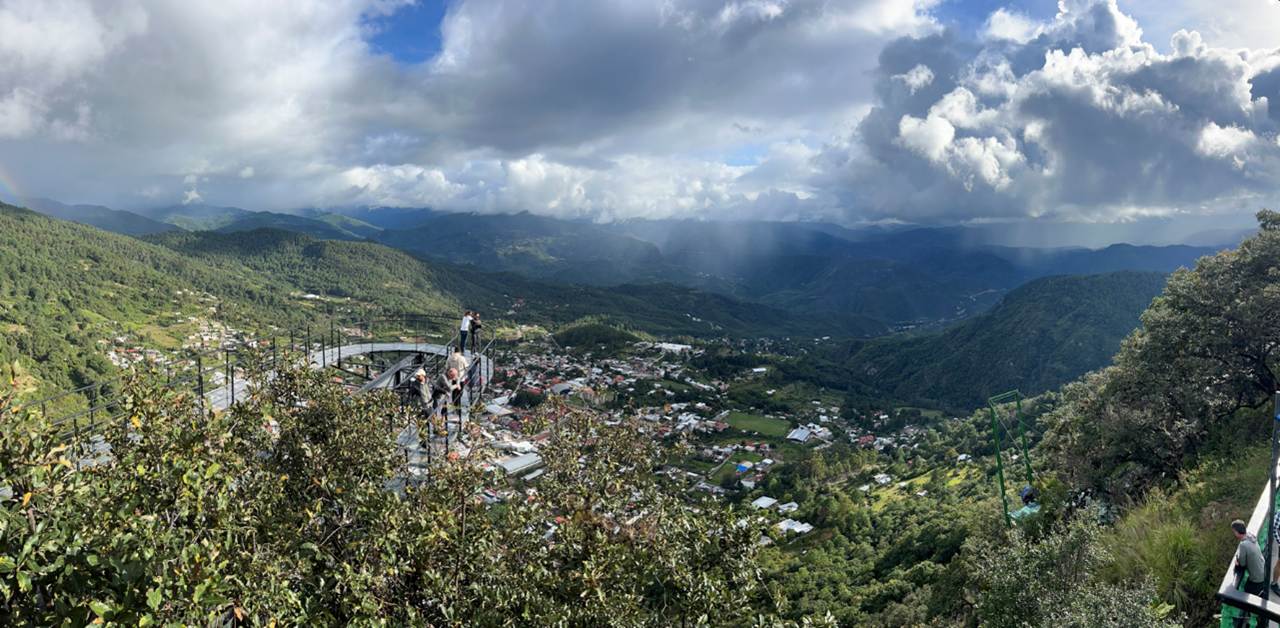
Lunch was a memorable affair at a restaurant perched on a hill above the town of Ixtlán. The venue featured a glass-bottom observation deck extending over the cliffside, offering a thrilling (or vertigo-inducing) view of the drop several hundred feet below and the lush green mountainous terrain beyond.
© Emily Griswold
Days 4 & 5: The Mixteca Alta Geopark
For the next two days, we moved our base to Santo Domingo Yanhuitlán to explore the Mixteca Alta Geopark, a UNESCO-recognized site celebrated for its unique geology, biodiversity, and deep cultural history. We were hosted by members of the local community who guided us through the trails, sharing knowledge about the traditional uses of the plants we encountered.
To manage our group size, we split into two teams, alternating routes over the two days so everyone could experience the full breadth of the Geopark.
The Tooxi Route: One day was dedicated to the "Hearts Trail" at the Tooxi agency. We climbed a ridge line where we encountered five oak species, including a shrub oak at the highest elevation that Oscar believes may be a new, undescribed species. The landscape here was punctuated by the imposing 20-foot stalks of Furcraea longaeva, a giant relative of the agave. The day concluded with a "Colors of the Earth" workshop, where we painted with watercolors created from local plant and mineral pigments—a creative way to connect with the very soil we had been hiking on.

© Roderick Cameron
The Tonaltepec Route: The alternate day focused on the community of Tonaltepec. We visited the Vista Hermosa area to see Q. crassifolia, Q. rugosa, and Q. liebmannii. The guides explained that Q. liebmannii is locally known as the "yellow oak" or "bread oak" because its wood is favored for fueling the ovens used to bake traditional bread.

© Wally Wilkins
The trek up Cerro Nudo Mixteco was a highlight. As we ascended the hillside, the trail transitioned from open grassland to a dense canopy adorned with the large, pink, waxy flowers of the bromeliad Tillandsia prodigiosa. Upon reaching a small plateau halfway up the mountain, we were greeted by an explosion of color. The ground was carpeted with Echeveria gigantea, their bright pink inflorescences standing two feet tall, surrounded by a diversity of flowering shrubs in purples, yellows, and reds.

Day 6: Giants and Ancients
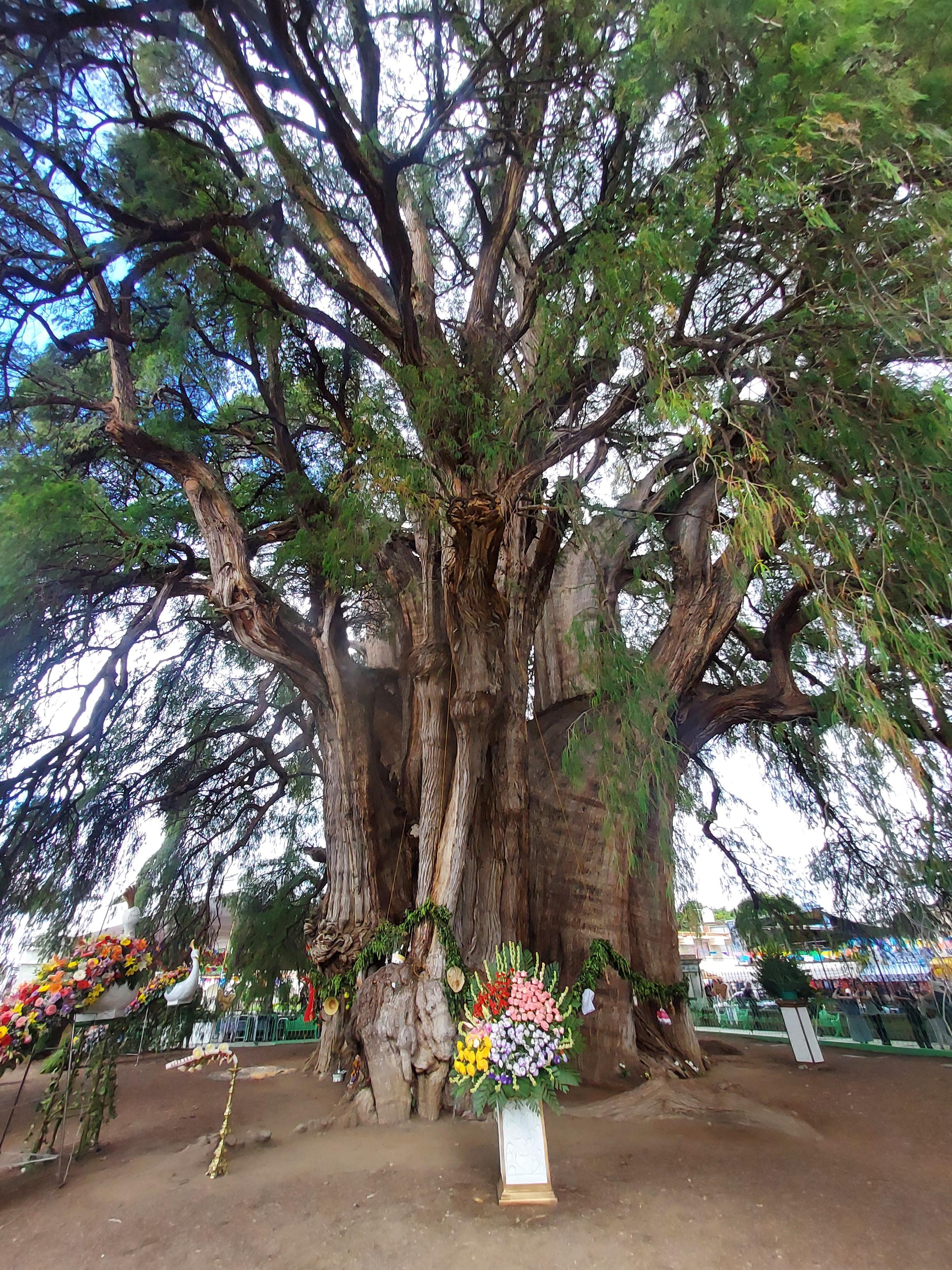
The final day of the tour was a relaxing finale, dedicated to two of Oaxaca’s most iconic attractions. While I missed this excursion to prepare acorns for the shipment back home, the group visited Santa María del Tule to pay respects to El Árbol del Tule.
© Roderick Cameron
This gigantic Montezuma Cypress (Taxodium mucronatum) is estimated to be around 2,000 years old, with a trunk diameter of 14.5 meters and a crown width of 58 meters. It is often cited as having the stoutest trunk of any tree in the world. Although a perimeter fence and floral arrangements kept the group at a safe distance, prohibiting any attempts to encircle it hand-in-hand, the sheer scale of the organism was awe-inspiring.

© Roderick Cameron
The tour concluded at Monte Albán, the ruins of the ancient Zapotec capital. While the archaeological site is devoid of oaks, it offered a chance to see Leucaena leucocephala, the leguminous tree known locally as guaje. It is from the Nahuatl name for this tree (Huaxyacac) that the name "Oaxaca" is derived—roughly translating to "the place of the guaje trees".

© Roderick Cameron
Reflections
As we said our goodbyes—sharing taxis to the airport and hurriedly processing acorns for customs—we reflected on a journey that covered incredible ground. We weathered stomach bugs, muddy roads, and the anxiety of agricultural inspections (some of us sadly losing precious acorns to weevils upon return), but the camaraderie remained high.

From the mossy cloud forests of Ixtlán to the eroding, colorful slopes of the Mixteca Alta, the Post-Conference Tour was a testament to the richness of Oaxaca’s biodiversity and the warmth of its people. A heartfelt thank you to the IOS, and especially to Antonio and Oscar, for an unforgettable expedition into the land of the oaks.
Content by the Same Author
The International Oak Society acknowledges the generous support of the following institutions:
Supporting Institutional Members



Standard Institutional Members