Editor's Picks
While working on a list of synonyms of European White...
Roderick Cameron
|
Aug 24, 2026
Report led by The Morton Arboretum will help prioritize oak...
Website Editor
|
Aug 06, 2026
Motivation
I live in the village of Dolné Dubové...
Jozef Čapkovič
|
Jul 20, 2026
Plant Focus
The only oak species endemic to Africa is rare in cultivation. It shouldn't be.
In Ireland and parts of England, and no doubt in some other countries, there has long been a tradition of creating landscape features composed of trees planted in a circle. What is the significance of that circle?

© Kenneth Allen. Reproduced under the Creative Commons Attribution-Share Alike 2.0 Licence
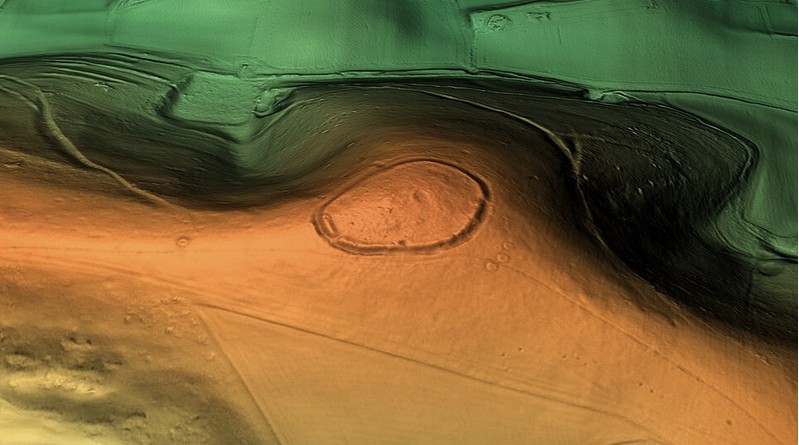
In southern England many famous tree circles, such as Chanctonbury ring, were planted on or around the earthworks of Iron Age hill forts, which, by nature of being on the tops of hills were more or less round, so a circular landscape feature appeared without, perhaps, any deliberate thought being given to it.
UK Open Government Licence 3
But the intentional planting of round groups of trees became fashionable in the 18th century under the influence of the landscape architects of the day. Were these imitating the hill fort plantings, or were they perhaps inspired by the Bronze Age megalithic stone circles that are also a feature of these landscapes? We tend to think of those circles as being characteristic of the “Celtic fringes” of Britain and Ireland, but in fact every populated continent has at some time (and often in the equivalent of the European late Neolithic or Bronze ages, say, 2500 BCE to 900 BCE) given rise to a culture that built them. This raises the question: why were stone circles circular? If they were inspired by natural features that the builders observed, it’s possible that they were echoing the disc of the sun or the full moon. As these circles often had an astronomical alignment, that conjecture seems reasonable.

© Nigel Cox. Reproduced under
Creative Commons Attribution-Share Alike License 2.0
We can’t know that for sure, but there is no doubt that circular monuments, whether of stone or of trees, have a powerful pull on the imagination. So there is a link between standing stones and circles, and between circles and deliberately planted trees. Is a triangle of the imagination completed by there being a link between trees and standing stones?
Well, yes. That is provided, perhaps, by the German artist Joseph Beuys, whose 1982 to 1987 work 7000 Oaks - City Forestation Instead of City Administration involved the planting of, indeed, 7,000 oak trees in the historic and war-damaged city of Kassel in central Germany, each tree being partnered by a basalt stele, or standing stone. In the early years of the project, the stones would be visually dominant, but gradually the oaks would surpass them until in time they died, when the stones would have a new function as memorials to the trees. There was no circular element to the plantings, which had to follow the street plans, but the oak-circle relationship is now being established by British artists Heather Ackroyd and Dan Harvey. They are building on that earlier tradition with their project Beuys’ Acorns - the Prelude & the Planting, which will result in the planting of 17 circles, each of seven oaks, in partnership with cultural centers.

with Orleans House Gallery 2025
© Studio Ackroyd & Harvey
Beuys, who was one of the founders of the German Green Party, saw this as the beginning of a regeneration movement that would spread far beyond Kassel and beyond Germany, and that has indeed been the case. Examples of projects inspired by 7000 Oaks include the Joseph Beuys Sculpture Park on the University of Maryland, Baltimore County and, in New York, the Dia Art Foundation’s installation of 37 trees and stone columns on West 22nd Street (mentioned by Roderick Cameron here). Both of these projects involved volunteers, reflecting Beuys’s belief “that every individual is an artist, that human beings are inherently creative, and the results of their endeavors are always a form of art.”

Courtesy Ronald Feldman Fine Arts, New York
Now Heather and Dan are extending the approach and fusing it with the tradition of planting in circles—in England. In 2007, they travelled to Kassel to collect acorns from Beuys’s oaks and sowed them as part of an open-ended research project. Surrey County Council has assisted by accommodating 115 of the trees at an impressive temporary holding ground. By using the Air-Pot ® growing system combined with drip irrigation, they have produced healthy and vigorous trees, which can be moved to temporary installations such as their exhibition at Tate Modern in London, in 2021, before their final planting out. Exhibitions have also been held in England (in London at the Royal Academy of Arts and other London venues, in East Anglia, and in Manchester) and in France (at Le Jardin Botanique, Bordeaux, and at Le Potager Du Roi and La Maréchalerie, Versailles). Circles completed so far are at the Sainsbury Centre Sculpture Park, University of East Anglia, Norwich; Harding’s Pits, King’s Lynn, Norfolk; Hampton Common, Twickenham, London; and at Thamesmead, London. Eleven further partnerships have been secured or are in the course of development.

© Scott218. Reproduced under the Creative Commons Attribution-Share Alike 3.0 Unported License.
The trees are planted at a respectable spacing of 7.7 m, sufficient to allow each to develop well while achieving canopy closure, eventually to create “a secluded place where people could be within the sanctuary of an arbor,” as Heather puts it.
Two themes that run through Heather and Dan’s work are environmental activism and collaboration between disciplines. To get some sense of this, you should really visit their website—and prepare to be there for quite some time. The documentary below, although made some time ago, is also a useful introduction to their work.
A final question: why was it important to Heather and Dan to go to the trouble of travelling to Kassel to collect acorns, when they could have simply bought oak seedlings at home? Surely, it’s a question of artistic provenance: as it's a work inspired by 7000 Oaks it should draw from 7000 Oaks. As growers of trees, to whom provenance is vitally important but in a different way, I think we can appreciate that.
We all endeavor to care for the environments that we cherish, and, as tree people, we have one of the more obvious and visible ways of doing it. Heather and Dan have taken a slightly different but no less committed path, and one that could serve as an inspiration to many.

© Studio Ackroyd & Harvey.
Further reading
Why planting a tree is a radical act - BBC.com
Content by the Same Author
The International Oak Society acknowledges the generous support of the following institutions:
Supporting Institutional Members



Standard Institutional Members