Editor's Picks
While working on a list of synonyms of European White...
Roderick Cameron
|
Aug 24, 2026
Report led by The Morton Arboretum will help prioritize oak...
Website Editor
|
Aug 06, 2026
Motivation
I live in the village of Dolné Dubové...
Jozef Čapkovič
|
Jul 20, 2026
Plant Focus
The only oak species endemic to Africa is rare in cultivation. It shouldn't be.
The bombing by the German Luftwaffe of the city of Coventry in the English Midlands on 14 November 1940 caused the partial destruction of its ancient Cathedral, which was left in that state as a permanent memorial to the Blitz.

Image: Andrew Walker, Creative Commons Attribution-Share Alike 3.0
Since that time, Coventry, and in particular its newly built Cathedral of St. Michael, have come to be seen as symbols of peace and reconciliation.
In the summer of 1968, a National Sculpture Exhibition was held in the ruins of the old Cathedral, with its recently consecrated replacement as a backdrop. At this time, John Lennon and Yoko Ono were planning the first of their Peace Events and decided that this exhibition would be a particularly appropriate launchpad. They managed to secure an invitation through a member of the organizing committee and were set to display a piece next to offerings from luminaries such as Henry Moore and Barbara Hepworth. John had in mind two oaks that would grow together, contained within a circular bench. It was to be titled "Acorns for Peace" and would symbolize peace and reconciliation, not only within Europe but also between East and West. Although John and Yoko’s intentions were clearly honorable, sadly elements of the ensuing story would be farcical.
The project didn’t get off to a good start. When John’s driver arrived the day before the opening of the exhibition, towing a trailer that contained the white wrought iron bench, the Cathedral’s Canon, Stephen Verney, refused to allow it to be unloaded. He was reportedly unhappy about the fact that John and Yoko were living in adulterous sin (they were married at the time, but not to each other), and he questioned whether the piece was in fact art. In the latter respect, he may have had a point. The bench was similar to something that could have been picked up in any upmarket garden center, and the gap through which the saplings would have to grow was hardly big enough to accommodate the trunk of even a single middle-aged oak.
Be that as it may, after a good deal of shouting and frantic telephone calls to famous sculptors, Canon Verney finally relented. The next day, John and Yoko arrived in John’s white Rolls Royce and in the standard gardening garb of white suits, and sowed two acorns, each in a plastic coffee cup, very close together along an east-west axis beneath where the bench would be located. This was the middle of summer, and they were sowing two acorns that must have been at least five months old, and had not germinated. Were they even viable? Almost certainly not, I suggest. It must be said that John and Yoko’s contribution to the arts dwarfed that of their gift to the science of arboriculture.

Image: Keith MacMillan
After posing for photographs and affixing a plaque which read "'Yoko' by John Lennon, 'John' by Yoko Ono", the couple left, to make history.
The story doesn’t end there, unfortunately. Two days after the exhibition opened, one of the event organizers took the decision to move the bench about 50 feet away and beyond the consecrated ground. He was quoted as claiming that “the Lennon-Yono [sic] piece is very good—but only as a garden seat and is being used as such by visitors.” By this time, the plaque had already been stolen.
John was furious. He dispatched his driver to reclaim the bench, which would later make a brief appearance in the 1988 film, Imagine. Meanwhile, two Beatles fans who had been at the ceremony returned to the Cathedral grounds and stole the acorns, coating them with nail varnish to preserve them. That could have been the end of the story, but the male fan, described as “a typical lad about town,” was arrested by Warwickshire Police for drunk driving and, for some reason best known to himself, handed over the acorns. Because they had no acknowledged owner and no apparent value, the couple couldn’t be charged with theft. The acorns were put away in an office drawer and re-emerged in 2023 when a police officer was clearing out his desk prior to his retirement. He donated them to the Liverpool Beatles Museum, where they are on display.
On 14 October 2005, Yoko returned to the Cathedral to plant two “Japanese oak” saplings, saying that "It was here in Coventry the first public manifestation of our message occurred, so it is great to be back here 37 years later, to continue something we started together, John would have loved it.” Twenty years on, we can report that the two trees are growing well. They are, unfortunately, too close together and also too close to an avenue of mature limes (Tilia ×europaea), so they will never grow to their full potential. And one rather significant question remained unanswered: what species of Japanese oak are they? We only had a few rather indistinct images from recent videos to inform us, until IOS member David Gooder volunteered to visit the Cathedral and try to obtain a specimen of the foliage. His generosity of spirit was to be rewarded with a shock.
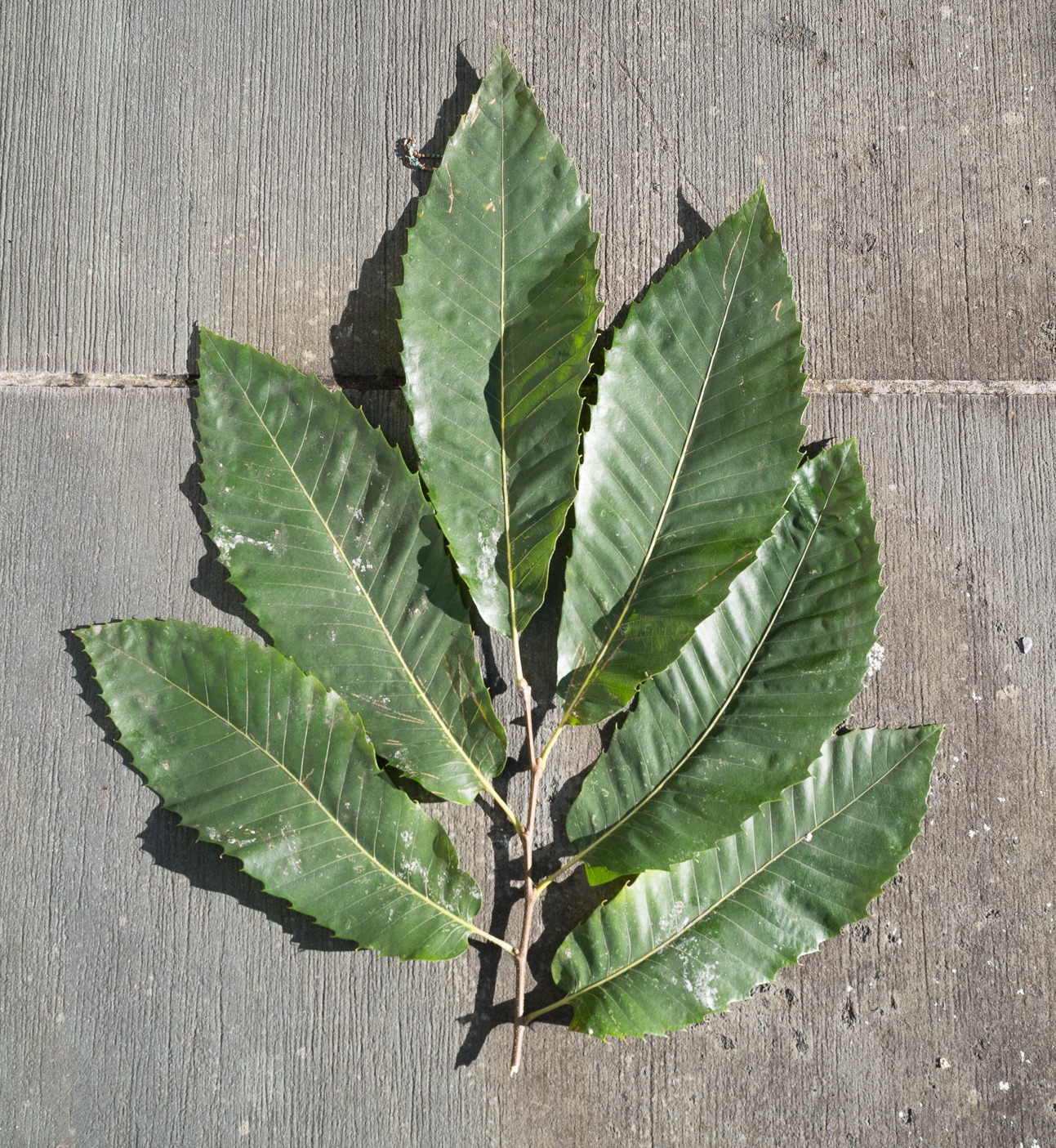
© Tom Gooder
A group of UK IOS members, and Roderick Cameron, pondered David’s images and soon concluded that these trees were not oaks. To be quite sure, we consulted Allen Coombes, who opined, as we had expected, that these were true chestnuts, Castanea sp., and most probably sweet chestnut, C. sativa.

© Tom Gooder
Poor Yoko. Her best efforts have been thwarted at every move, it seems. At former IOS President Roderick’s suggestion, we have made contact with the Cathedral authorities to investigate the possibility of the Society sourcing two genuine Japanese oaks that might eventually be planted in the Cathedral grounds. Our approach has been welcomed, but it may be some time before the Cathedral authorities can provide a definitive response. If any members are in a position to help with the provision of those trees, do please get in touch.
With thanks to David Gooder, James MacEwen, Roderick Cameron and Allen Coombes for their help with this investigation.
Content by the Same Author
The International Oak Society acknowledges the generous support of the following institutions:
Supporting Institutional Members



Standard Institutional Members