Editor's Picks

While working on a list of synonyms of European White...
Roderick Cameron
|
Aug 24, 2026
Report led by The Morton Arboretum will help prioritize oak...
Website Editor
|
Aug 06, 2026
Motivation
I live in the village of Dolné Dubové...
Jozef Čapkovič
|
Jul 20, 2026
Plant Focus
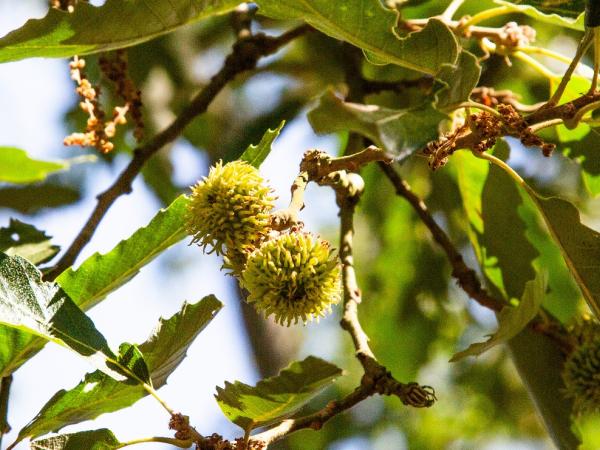
The only oak species endemic to Africa is rare in cultivation. It shouldn't be.
This is meant as a refresher to Guy Sternberg’s article found in International Oaks No. 24. I won’t go into such great detail, but I recommend reading that article again for those that may be a bit squeamish about pruning their own trees or may want a refresher about the physiology involved. The particular tree in question is a Q. ×schuettei (planted as Q. bicolor) growing in a park landscape I am now responsible for. This tree had not been pruned for many years, if at all and as a result it had grown competing leaders. These co-dominant stems were already becoming an issue and if left unchecked, would become a much larger issue. Many times co-dominant stems develop included bark* which will become weaker as the tops grow taller, heavier and create more sail. I decided to reduce these stems in stages instead of removing them all at once, which is easier on the tree**. Some of these competing stems will be reduced and redirected for lateral growth. The largest competing stem will be removed altogether over the next two growing seasons as the smaller branches fill in the open space. Large holes left in the canopy are prone to sun-scalding and should be avoided when possible.
I will need to check the tree in-between prunings and may need to remove or reduce any water sprouts that may pop up as a result of these directional cuts.
*Included bark occurs at very narrow branch angles and as the tree grows more caliper, these stems effectively push away from one another creating weak points.
**”Easier” in that less leaf matter/food production is lost and smaller holes in the canopy mean less chance for sun scalding. The tradeoff is that the ultimate final cut will be slightly larger later on meaning there will be a larger wound to seal.
 |
 |
| Co-dominant stems | Co-dominant stems split again |
 |
 |
| Undesirable branch angles | Mess of stems |
 |
 |
| Reducing stems to redirect growth | Reducing large stem over time |
 |
| Finished (for now) job |
 |
 |
| Closer look at finished job | Handful of scion! |
Content by the Same Author
The International Oak Society acknowledges the generous support of the following institutions:
Supporting Institutional Members


Standard Institutional Members