Editor's Picks
Images and insights from Ezra Barnea’s journey to Cyprus’s...
Ezra Barnea
|
Jun 13, 2026
Endangered oak Quercus hinckleyi shows strong genetic...
Website Editor
|
Jun 09, 2026
New paper should significantly change our approach to...
Steve Potter
|
Jun 09, 2026
Plant Focus
Roderick Cameron and Carlos Vila-Viçosa give an account of this intriguing species from northwestern Iberia with a complex taxonomic and...
This article by Chris Lee (CALFIRE) and (Susan Frankel, USDA Forest Service) was first published in the April 2018 newsletter of the California Forest Pest Council. It is reproduced here with the Council's kind permission.
Plant pathologists from the California Department of Agriculture (CDFA) recently identified a new species of fungal pathogen that infects oak, chinkapins, and tanoaks. Until recently, North American diagnosticians called all species of the genus Tubakia that infects oaks in North America, Tubakia dryina, because they all have very similar morphological features to this European fungus. However, a new study shows that the North American
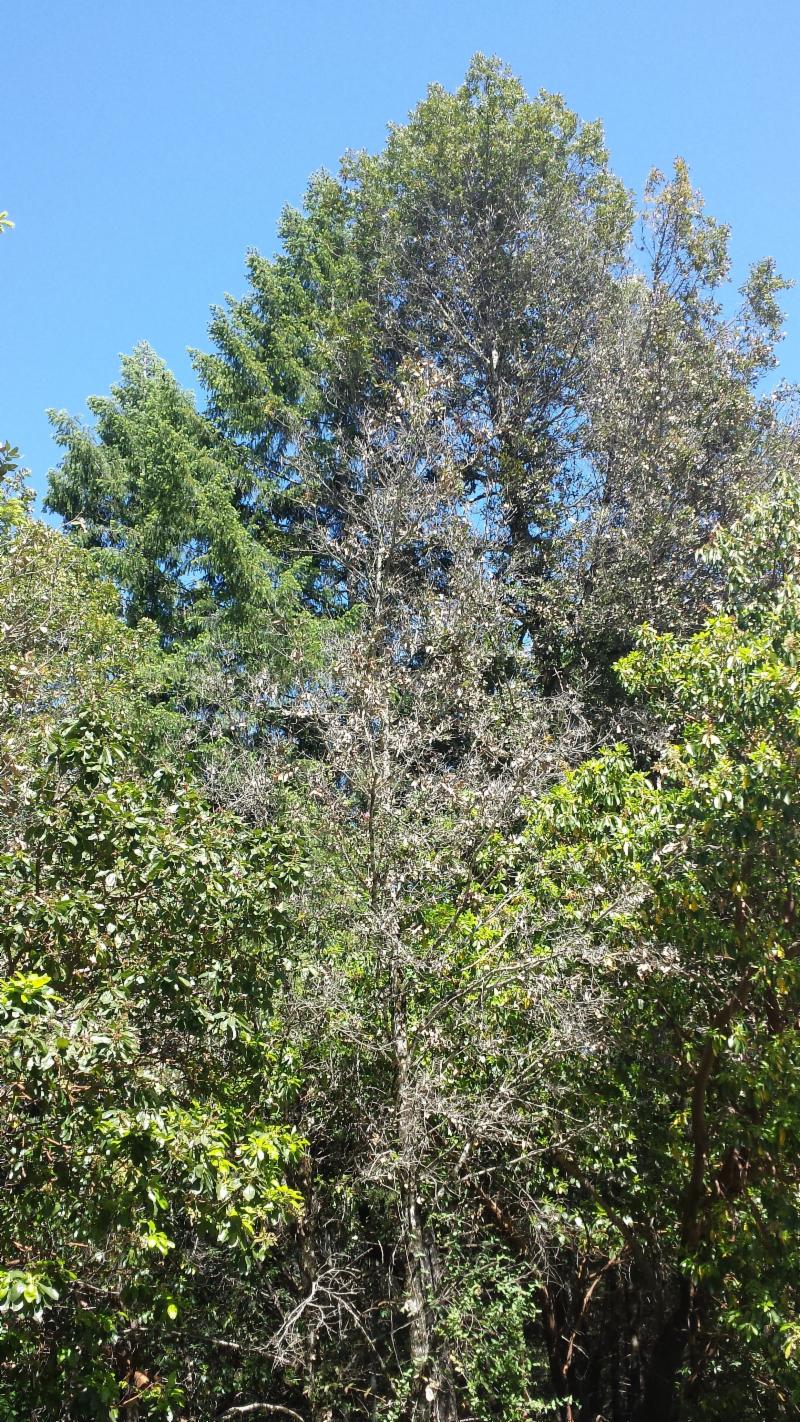 |
| Lower crown defoliation of tanoak caused by Tubakia californica. © Chris Lee, Cal Fire. |
species vary genetically from Tubakia dryina. Among these is the newly recognized California species.
Tubakia species are common residents of leaves and twigs of many tree species, often causing no visible damage but sometimes causing conspicuous leaf symptoms. The newly delineated California species, which CDFA pathologists Suzanne Rooney-Latham and Cheryl Blomquist named Tubakia californica, is known to cause a foliar disease on mature California black oak (Quercus kelloggii), interior live oak (Quercus wislizeni), coast live oak (Quercus agrifolia), chinkapin (Chrysolepis& chrysophylla), and tan oak (Notholithocarpus densiflorus). The most severe symptoms usually occur on California black oak. Infected leaves from the previous season's growth remain attached on the branches in the spring instead of fully defoliating in the fall. In the Groveland area of the Sierra Nevada foothills, the new growth appears healthy until late August when small brown lesions develop on the leaves, predominantly on the underside. Lesions enlarge over time and by early September, the associated lateral leaf veins become brownish black and vein discoloration extends to the midrib. By October, many of the affected leaves become dry and uniformly brown with black veins. Small black Tubakia spore-bearing structures develop in late September on leaf veins, leaf blades and petioles. On tanoak, the pathogen causes progressive defoliation from the bottom of the crown upward. Overall, symptoms seem to develop later in the season in the Sierra Nevada foothill locations (Tuolumne and El Dorado Counties) than in the other lower elevation California counties. Symptoms are more likely to be present in low-lying areas within a site and in the lower portion of the canopy. In at least some black oak and tanoak cases, the disease has led to mortality, creating a hazardous situation and necessitating tree removal.
Often, when a new fungal plant disease is discovered, it is difficult to know if the fungus that causes the disease is newly introduced or native to a specific plant host and geographical area. As was demonstrated in the recent Tubakia paper, characterizing the genetic diversity of a specific group of fungi including their hosts and geographical areas allows mycologists and plant health regulators to determine if a specific fungal species is likely native or a potentially exotic species. To date, Tubakia californica has been detected in many parts of California (Del Norte, El Dorado, Humboldt, Mariposa, Marin, Shasta, and San Luis Obispo Counties) and appears to be a native foliar pathogen on members of the Fagaceae.
For more information, see:
Braun, U, Nakashima, C., Crous, P.W., Groenewald, J.Z., Moreno-Rico, O., Rooney-Latham, S., Blomquist, C.L., Haas, J., and Marmolejo, J. 2018. The Phylogeny and Taxonomy of the Genus Tubakia s. lat. Fungal Systematics and Evolution 1: 41-99. Available at http://fuse-journal.org/images/Issues/Vol1Art4.pdf.
Content by the Same Author
The International Oak Society acknowledges the generous support of the following institutions:
Supporting Institutional Members



Standard Institutional Members