Editor's Picks

While working on a list of synonyms of European White...
Roderick Cameron
|
Aug 24, 2026
Report led by The Morton Arboretum will help prioritize oak...
Website Editor
|
Aug 06, 2026
Motivation
I live in the village of Dolné Dubové...
Jozef Čapkovič
|
Jul 20, 2026
Plant Focus
The only oak species endemic to Africa is rare in cultivation. It shouldn't be.
The evidence suggests that the University of California is at the forefront of research into the implications of climate change for oaks in the future. We have reported on the work being carried out by Dr. Blair McLaughlin and her team at UC Santa Cruz and shared a conversation with Blair about California’s oaks in a changing climate. And now we have two new papers from Garden Director and Distinguished Professor Victoria L. Sork and her team at UCLA. The first, on the implications of a warming climate for the coast live oak, Quercus agrifolia, has been summarized very briefly in our latest Research Roundup (Landscape Genomic Analyses of Quercus agrifolia Née Predict Patterns of Adaptedness to Future Climate and Provide Guidance for Conservation) and the second can be found in the latest edition of our our Journal (International Oaks No. 36 (2026): 165–174, Preserving Oaks and Oak Ecosystems Vulnerable to Climate Change, by Victoria L. Sork, Ryan Buck, and Alexander Goetz).
The latter paper describes two case studies, one involving a long-term common garden provenance trial which monitored the growth and survival of progeny from 658 specimens of the Californian endemic valley oak, Q. lobata. In common with many other investigations, it used a climate change scenario known as Relative Concentration Pathway or RCP 8.5 to represent “business as usual”. Recently the energy systems and climate science communities have advised that, in the light of reductions in coal burning, this scenario can now be considered too pessimistic. Future modelling will rely on an alternative scenario, but the implication for our current understanding is that we should draw broad conclusions, rather than precise predictions, from models that employed RCP 8.5. In this case the broad conclusion is that Q. lobata from warmer climates consistently outperforms those from cooler climates. It is likely that the growth of this oak will decline across much of its range, especially in low-elevation inland areas, while coastal regions and higher-elevation southern regions will show less extreme decline, and even increases, in tree size.
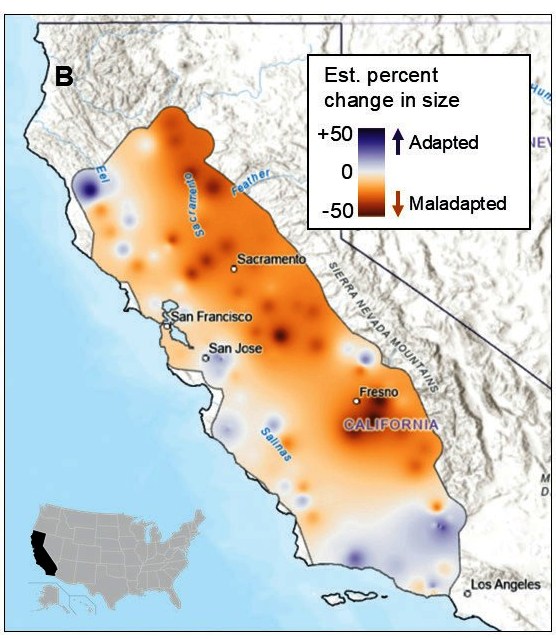
Figure from Sork et al. (2026).
The group tested some hypothetical scenarios for transferring acorns to mitigate the effects of climate change. They found that local sourcing of acorns results in outcomes that are not significantly different from a random selection approach. In contrast, matching seeds to the future climate of a site results in significant adaptation.
Mismatches to non-climatic environmental characteristics, such as soil microbiota, and genetic risks, such as outbreeding depression, may result from moving genotypes over long distances. This investigation found that transferring acorns over such distances is not necessary, which means it is possible to use seed sources not too distant from the replanting site.
The second case study describes a landscape genomic analysis using whole gene sequences of 163 trees distributed throughout the range of another Californian endemic, Q. douglasii (blue oak). Landscape genomics is the study of geographic patterns of genomic variation associated with climate gradients. Utilizing knowledge of those patterns, the group modeled which stands would have higher adaptedness to future climate conditions, rendering them more likely to survive and grow better than stands in other regions.
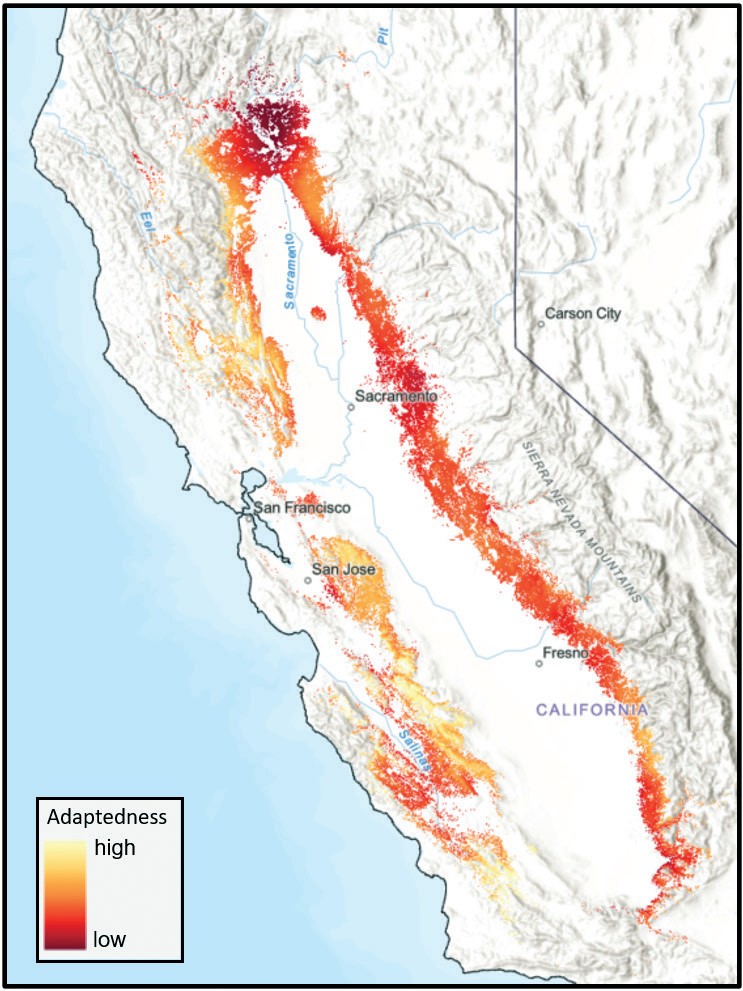
Figure from Sork et al. (2026).
Landscape genomic tools were also used to identify pre-adapted seed sources and test if they would significantly increase adaptedness of stands in hypothetical planting sites with already high adaptedness, compared to selecting seed sources randomly within a restoration site or locally (within 500 m of the restoration site), or if no action was taken. The use of seed sources pre-adapted to the future climate of the planting site was shown to be the only method that resulted in an increase in adaptedness, whereas choosing seed source trees either randomly or locally actually resulted in a predicted decrease in adaptedness of future trees.
Taken together, this work and that carried out by Blair McLaughlin’s team has shown that the endemic Californian oaks are, in general, maladapted to the current and likely future climates, but that the protection of existing climatic refugia and carefully planned and executed interventions based around the facilitated dispersal of climate-adapted genotypes can meet likely future climate challenges. Of course, other factors which affect survival, including grazing pressure, pests and pathogens, deliberate deforestation and wildfires, must also be addressed, but thanks to this ground-breaking work there is hope for California’s endemic oaks.
Works cited
Buck, R. C., H. S. Butterfield, E. Hiroyasu, J. Howard, J. Knapp, Z. Principe, and V.L. Sork. 2026. Landscape Genomic Analyses of Quercus agrifolia Née Predict Patterns of Adaptedness to Future Climate and Provide Guidance for Conservation. Evolutionary Applications 19(4): e70224 [link]
Potter, S. 2026. California’s Oaks in a Changing Climate: In Conversation with Dr. Blair McLaughlin. International Oak Society website. [link]
Sork, V.L., Buck, R., Goetz, A. 2026. Preserving Oaks and Oak Ecosystems Vulnerable to Climate Change. International Oaks 36: 165–174.
Content by the Same Author
The International Oak Society acknowledges the generous support of the following institutions:
Supporting Institutional Members



Standard Institutional Members