Editor's Picks
While working on a list of synonyms of European White...
Roderick Cameron
|
Aug 24, 2026
Report led by The Morton Arboretum will help prioritize oak...
Website Editor
|
Aug 06, 2026
Motivation
I live in the village of Dolné Dubové...
Jozef Čapkovič
|
Jul 20, 2026
Plant Focus
The only oak species endemic to Africa is rare in cultivation. It shouldn't be.
This new entry in our series on Oak Poetry features a poem by Ivan Krylov, a Russian fabulist (writer of fables). Its moral is perhaps apt for current times, reminding us that we often enjoy the benefits of science, nature, and knowledge without respecting or protecting the roots that sustain them.
If you would like to propose a poem for inclusion in this series, please click here.
[English translation below]
Свинья под дубом
Свинья под Дубом вековым
Наелась жёлудей до-сыта, до-отвала;
Наевшись, выспалась под ним;
Потом, глаза продравши, встала
И рылом подрывать у Дуба корни стала.
«Ведь это дереву вредит»,
Ей с Дубу Ворон говорит:
«Коль корни обнажишь, оно засохнуть может». —
«Пусть сохнет», говорит Свинья:
«Ничуть меня то не тревожит;
В нем проку мало вижу я;
Хоть век его не будь, ничуть не пожалею;
Лишь были б жолуди: ведь я от них жирею». —
«Неблагодарная!» примолвил Дуб ей тут:
«Когда бы вверх могла поднять ты рыло,
Тебе бы видно было,
Что эти жолуди на мне растут».
Невежда также в ослепленье
Бранит науки и ученье,
И все ученые труды,
Не чувствуя, что он вкушает их плоды.
Pig Under the Oak
[Verse translation by Bernard Pares, 1926]
A swine, beneath an ancient oak
Upon the acorns gorged and stuffed all day
Then in the shadow snoring lay;
At last with heavy eyes he woke,
Got up, and with his snout began the roots to poke.
'Why don't you see? That hurt the tree,"
A raven, on a bough, called out reproachfully.
"If you lay bare the roots, you'll make the tree decay."
Says Swine: "Well, let it; as for me,
That won't disturb me in any way.
It's not much use, that I can see,
And if it went for good, I'd never fret for that;
It's acorns that I want; it's they that make me fat."
"Ungrateful one!" the oak replies in tone severe;
"If you could raise your snout and look up here,
Why then, my friend, you'd see
That all these acorns grow on me."
The ignorant are just as blind;
They mock at knowledge, scoff at learning,
With scorn the toils of study spurning,
Forgetting, they enjoy its fruits of every kind.
[Literal translation by Google, 2026]
The Pig, under the Age-Old Oak,
Ate her fill of acorns, till she was full;
Having eaten her fill, she slept beneath it;
Then, opening her eyes, she rose
And began to tear at the Oak's roots with her snout.
"But this is harmful to the tree,"
The Raven says to her from the Oak:
"If you expose the roots, it may dry up." —
"Let it dry up," says the Pig:
"That doesn't bother me at all;
I see little use in it;
Even if it were gone forever, I wouldn't regret it at all;
If only I had acorns: after all, they make me fat." —
"Ungrateful!" The Oak said to her:
“If only you could lift your snout up,
you would see
that these acorns are growing on me.”
The ignoramus, too, in his blindness,
scolds science and learning,
and all learned works,
not feeling that he is tasting their fruits.
You can hear a reading of the poem, evidently aimed at young audiences, here. Or listen to a more toned-down version here.
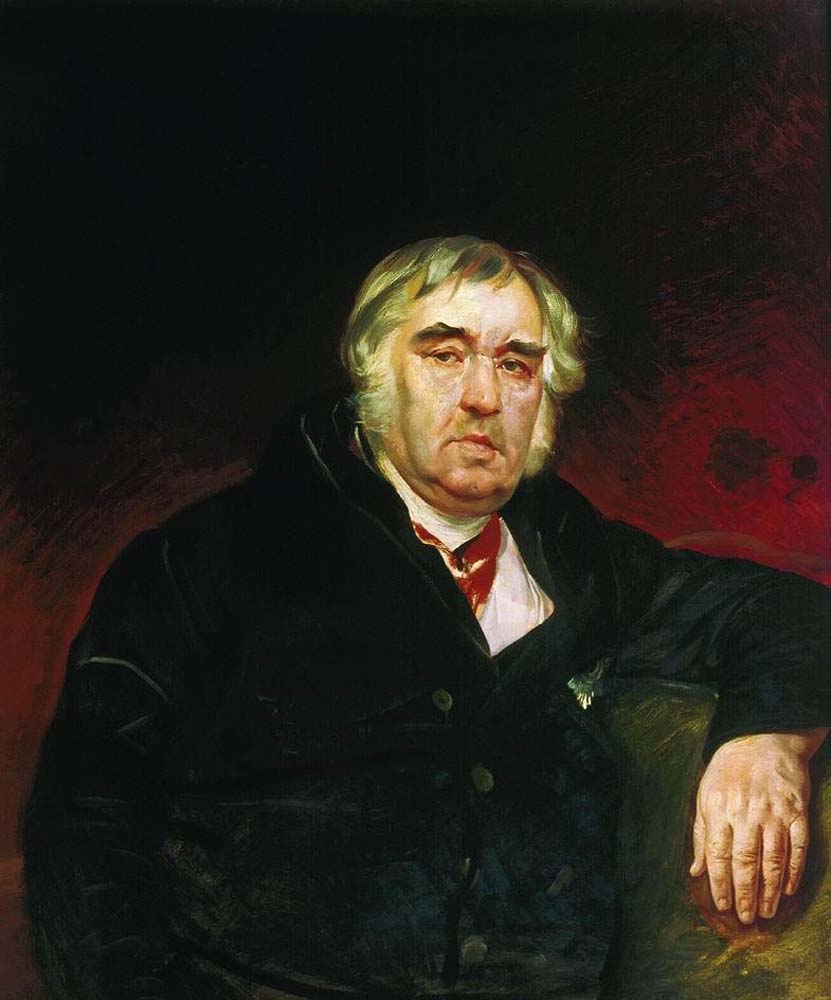
The State Tretyakov Gallery, Moscow, Russia
Ivan Krylov was born on 13 February 1769 in Moscow to an impoverished military family and rose to prominence as Russia’s foremost writer of fables. After early work as a dramatist and journalist, he discovered his true medium around 1805 when he began adapting and then composing original fables, many inspired by Aesop and La Fontaine but transformed into distinctly Russian tales. His animals—foxes, crows, wolves, and sheep—served as allegories for human folly, corruption, and wisdom, expressed in a colloquial style that resonated widely. Krylov published his first collection of fables in 1809, gaining imperial patronage and a long tenure at the St. Petersburg Public Library, where he worked for three decades. Over his career he produced nine volumes of verse fables, embedding sharp social satire in seemingly innocent stories, and many of his aphorisms entered everyday Russian idiom. He died in St. Petersburg on 21 November 1844, leaving a legacy as one of the most influential voices in Russian literature, admired for blending humor, realism, and moral critique.
Content by the Same Author
The International Oak Society acknowledges the generous support of the following institutions:
Supporting Institutional Members



Standard Institutional Members